Posts

NDM: the effect of online technology on newspapers

Image
NDM: the effect of online technology on newspapers Based on the handout you've read ( Newspapers: The effect of online technology )  and the links provided, a nswer these questions on your blog with  detailed ,  in-depth paragraphs . Remember, critical autonomy means forming  your own opinions  on these issues. 1 ) Do you agree with James Murdoch that the BBC should not be allowed to provide free news online? Why? From an institutional aspect, I do agree with James Murdoch that the BBC shouldn't be allowed to provide free news online as this paves the way for consumers to become more accustom to receiving free content. As the BBC is a well established brand, this would make it harder for other institutions to put up a paywall as consumers may feel that there is no need to pay for their stories due to the BBC having free content. However, I do believe that every consumer should have access to the news to know what is going on in the world as people ...
Build The Wall Analysis

Build The Wall Analysis Your main work is some in-depth reading which will provide excellent preparation for  university . David Simon, creator of critically acclaimed TV series The Wire and a former journalist, has written a passionate defence of the newspaper industry in the face of the new and digital media onslaught. This will easily take you  a couple of hours  to complete - make sure you put the time in. The article, Build The Wall, is available here on the Columbia Journalism Review website . Your tasks are as follows: Read the article in  full  and c reate a  blogpost  on your MEST3 Exam Blog called 'Build The Wall analysis'.  1) Summarise each section in  one sentence : Section 1 (To all of the bystanders reading this…) This part of the article reviews how consumers should pay for the content that newspapers and online articles provide so that the company could benefit and extensive journalism could be done.  ...

NDM case study: How has news changed?

Image
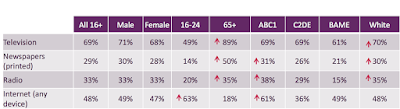
NDM case study: How has news changed? 1) Read this  Ofcom 2016 report on the consumption of news in the UK . Note down the key statistics and changes that Ofcom document. The survey has approximately 150 codes for different potential sources for news. Also allows respondents to nominate their own sources which yields a further 700 or so, including regional sources.   Includes various social media and intermediary sources. BARB (Broadcasters’ Audience Research Board) is the official industry currency for TV consumption. TV is the most-used platform for news nowadays (used by 69% of adults), the internet has increased in use compared to 2015 (48% vs. 41%).  Half of 16-24s say they use TV for news compared to nine in ten of those aged 65+.  One in twenty (6%) use all four main platforms for news. One in five (19%) uses only TV for news.  Three in ten (29%) now use a mobile for news.  BARB shows in 2016, adults watched an average of 110 ...

NDM: The decline of the newspaper industry

NDM: The decline of the newspaper industry The future of newspapers Read  this article from the Economist on the future of newspapers . On your blog, create a blogpost called 'The future of newspapers' and  write a paragraph  summarising the argument the article makes. Then answer the following questions: This article makes the argument that newspapers are in decline as new digital media is on an incline. It is noted in the article that more of the younger demographic are using the internet to access the news instead of purchasing a newspaper and looking at global news. The theory behind the extinction of newspapers is said to be the first quarter of 2043 and as a result of this decline, jobs and advertisers are beginning to suffer. This is due to more advertisements on the internet being specifically matched to meet consumer interests instead of there being broad and numerous amount of advertisements. Newspapers have tried to fit more of the market sector of news ...

Week 4 New/Digital Media

Image
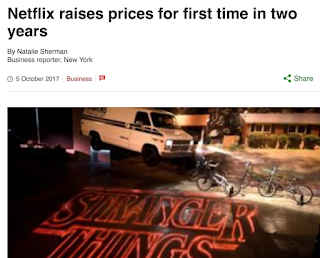
Year 13: Weekly New/Digital Media homework Netflix raises prices for first time in two years BBC - 05/10/17 This article notes about the increased Netflix subscription prices and the reasoning behind this. Rising competitors such as Amazon, Hulu and etc have contributed to Netflix increasing their subscriptions and focusing on Netflix original programmes.   A standard UK plan will rise 50p to £7.99 a month. Premium subscription for four simultaneous users rises £1 to £9.99 a month. The standard US plan increases by $1 to $10.99 a month, with a $2 rise to $13.99 for the premium option. A basic subscription in the UK, which does not offer high definition viewing, remains at £5.99 a month. Netflix said in July it has 104 million subscribers globally , while revenues rose 32% in the second quarter to $2.8bn. Shares in Netflix closed 5.4% in New York, bringing the stock's gain this year to 56%. In my opinion, I think that this increase may aff...

Week 2 New/Digital Media

Image
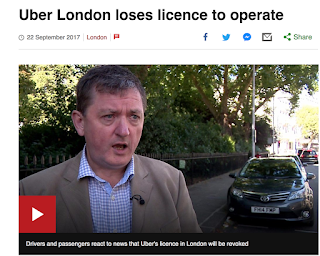
Year 13: Weekly New/Digital Media Homework Uber loses its license in London BBC - 22/09/17 This article explores the reason why Uber's license was revoked in London and how this could affect the employees and consumers. This talks about the safety of passengers being at risk due to there not being sufficient background checks on Uber drivers leading to multiple cases of misconduct and therefore the reason why it loses its license in London.  TfL's concerns include Uber's approach to carrying out background checks on drivers and reporting serious criminal offences. Uber's current licence is due to run until 30 September. 3.5 million passengers and 40,000 drivers use the Uber app in London. Chief executive Travis Kalanick resigned in July  following a series of scandals and criticism of his management style. In June,   20 staff were   sacked after a law firm investigated specific complaints made to the company about sexual harassment, bullyin...

Week 3 New/Digital Media

Image
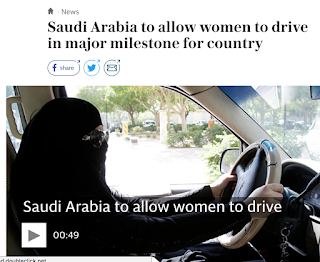
Year 13: Weekly New/Digital Media homework Women are allowed to drive in Saudi Arabia.   Telegraph - 26/09/17 This article is about the increasing development of women in Saudi Arabia and the consent that they now have to drive. Also, this article contains the battles and protests that the women have faced in their community as a result of them having to live in the shadow of their male companions. The development of their rights and independence is explored.  Saudi Arabia is the only nation in the world where women were forbidden from getting behind the wheel of a car. There is no formal law banning women from driving but  the government refuses to issue them permits.  The formation of a ministerial body has to give advice within 30 days and then implement the order by June 2018. I n June 2011, about  40 women got behind the wheel and drove in several cities  in a protest sparked when Manal Sharif, one of the founders of the m...